

Turning your love for pets into a well-paying business isn’t as scary as it seems.
The startup costs are low, and people keep spending more on their pets. According to the American Pet Products Association, pet owners in the United States of America spent $158 billion on their pets in 2025 alone, which was 3.7% from the previous year. By 2026, that amount is expected to reach $165 billion.
Pet care continues to be one of the most reliable small-business ventures at the moment because of this kind of consistent growth. And you do not need a big team. You can start solo. All you need is your love for animals, a reliable schedule, and good communication.
However, if you plan on learning how to start a pet sitting business properly, the goal should not be just picking up a few casual jobs.
Let us tell you what your goal should be
Building a reputable company that customers consistently choose should be your aim. Provide a service that offers appropriate insurance, written contracts, transparent pricing, recurring customers, and a smooth booking process that doesn't require constant messaging.
In this guide, we will help you understand how to start a pet sitting business from scratch. We will teach you the most important things: how to organize bookings, plan services, manage the legalities, set pricing, get the first clients, and develop trust through reviews.
TLDR: we will guide you how to grow your business without burning out.
Is a Pet Sitting Business The Right Option for You?
Let's face it, if someone wants to create a flexible and affordable service business, pet sitting seems like a fantastic idea.
But at the end of the day, it's still actual work.
It entails taking dogs for walks regardless of the weather, cleaning up after mishaps, medicating obstinate animals, working on holidays, particularly when demand is strong, and answering calls in the early morning or late at night.
Not only is it physically demanding, but also requires mental perseverance.
How many walks, overnight stays, visits, and pet sitting sessions you can actually fit in a day without burning out, hurrying clients, and degrading service quality will determine how much money you make. The schedule will therefore be the largest obstacle if you intend to work alone.
The industry for pet sitting is expanding quickly as well. It was estimated to be worth $2.69 billion in 2024 and is expected to expand at a rate of nearly 12% annually to $5.14 billion by 2030 as more owners choose individualized, in-home care over boarding kennels.
Nevertheless, there is also a significant upside. The initial costs of starting a pet sitting business are frequently as low as $500. It is not necessary to have a storefront, a sizable inventory, or an office.
When you successfully establish trust, you begin to receive repeat reservations, particularly for frequent business travel, vacations, holiday travel, and regular evening walks.
Professionalism is what separates operating a legitimate business from a casual pet sitting endeavor.
You must think like a business owner if you want to develop a real business. You must employ written agreements, obtain insurance, and create a dependable system for your clients.
Step 1: Decide The Niche and List The Services
Before you start working, decide what kind of pet sitting services you want to offer. Pet sitting is not just one single service. It can include several services, and each service can affect your schedule, timings, and price differently.
Some customers may require a pet sitter to watch their animals while they are traveling. While they are at work, some people may be seeking a quick drop-in to take their pet for a short stroll.
We advise beginning with services you are confident in your ability to provide on a regular basis. Because drop-in visits are simple to arrange around a small service area, they are an excellent place for a new firm to start.
To guarantee a consistent flow of income over the week, we also advise including dog walking in the mix. Although it can limit how many clients you can take in a day, overnight sitting is very rewarding. House-sitting with pets can come with additional tasks like bringing in mail, watering the plants, and keeping the house clean while the owner is away.
You can do many things, but avoid making things too difficult. On the first day, you don't have to provide everything. It is easier to handle if you start with a targeted service menu.
Both your earnings and the number of bookings you can process in a given day will depend on the service mix. Drop-ins, for instance, are simpler to handle, but overnight reservations may restrict availability.
Before you decide the rate list, compare services and look at typical pet sitting rates to make offers realistic.
Step 2: Create an Easy-to-Follow Pet Sitting Business Plan
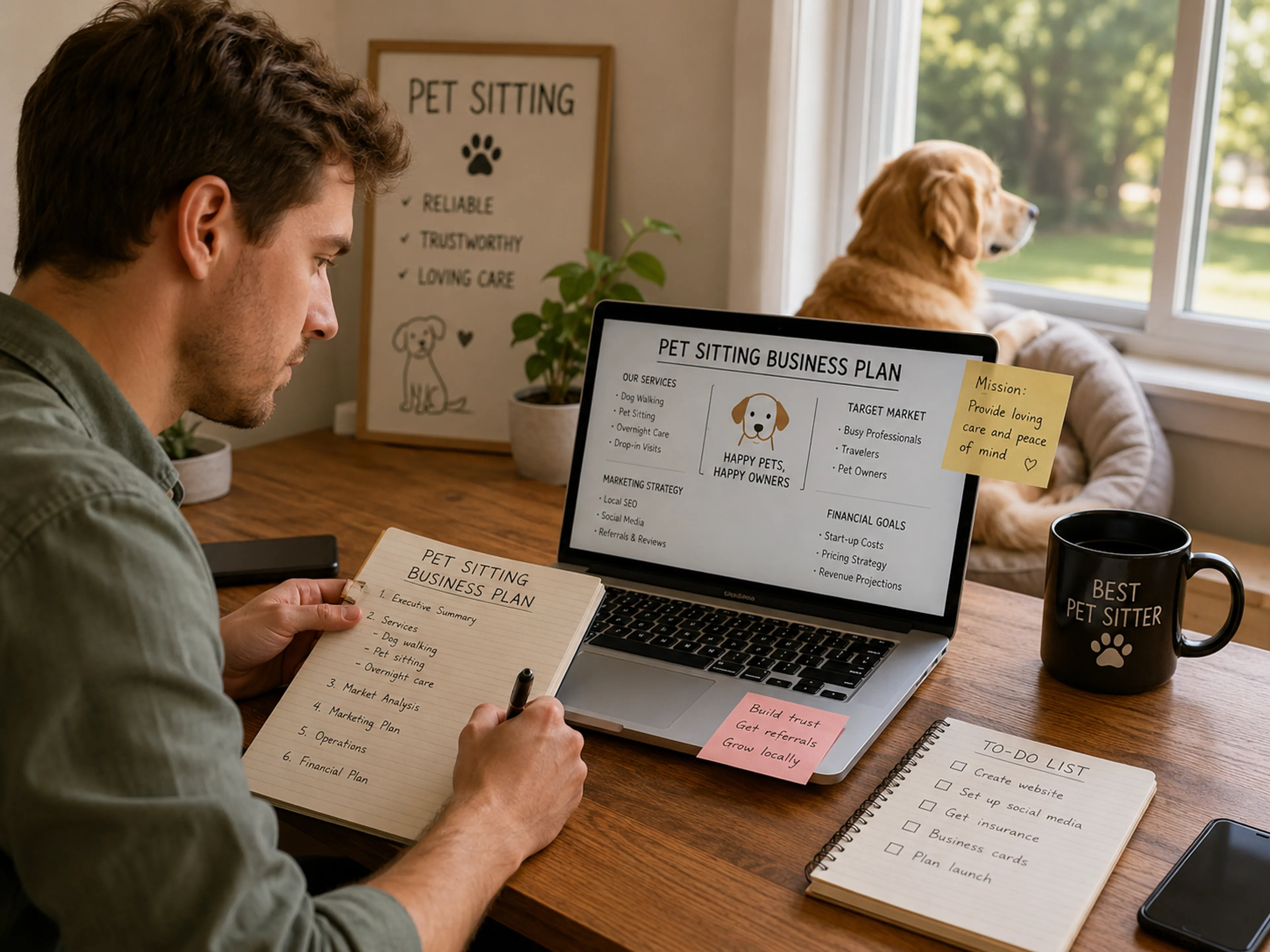
A simple one-page pet sitting business plan is enough in the beginning. Think of it as a working checklist instead of a bank-loan proposal.
It should help you make decisions that matter and answer basic questions like where you operate, what services you offer, and how much you charge.
What to include in the one-page business plan?
Start with a list of services you plan to offer.
Will you offer dog walking, small-animal care, drop-ins, or overnight visits?
It will be simpler to handle a narrower service radius, particularly if you wish to get several reservations in a single day.
Next, focus on pricing. You should choose whether to charge by the night, hour, visit, or walk. Additionally, consider additional costs for longer trips, busy times, holidays, and additional pets.
Calculate your monthly expenses for marketing, software, supplies, insurance, business registration, and travel.
We recommend a realistic goal for the first few months. This could be five repeat customers, a certain income target, or four vacation bookings. This will help measure early progress.
Step 3: Name The Business and Get it Registered
Once you have shortlisted the services, choose a name for the business.
The business's name is the first thing a potential customer sees. So, make sure that it is easy to spell, easy to remember, and gives a clear idea of what you do.
The best pet sitting business names are often very simple instead of an overly clever play on words. The client should be able to look at the name and understand what the business offers.
- Include the location in the headline, such as West County Pet Care or Palm Beach Pet Sitting.
- Emphasize the service, such Cozy Cat Visits or Happy Paws Dog Walking.
- Use terms that are founded on trust, such as dependable, home, or care.
- Make it sufficiently general to allow for the addition of overnight care, dog walking, or other services at a later time.
Make sure the name isn't already in use in the target location before making a final decision. Look for website domains, social media accounts, and local company listings. This will help prevent misunderstandings.
Second, register the company in accordance with local regulations. To keep your personal and business finances separate, you might begin as a sole proprietor or form an LLC. Also, look into a general business license or home-based business permit.
These requirements can differ by state, county, city, and country. Confirm with the local government office before taking any bookings.
Step 4: Get Insurance and Draft a Contract Agreement
Contracts and insurance are crucial because of this very reason. They are more than just formality. They are essential to carrying out the work in an ethical manner.
Pet sitting business insurance can help protect your business if something goes awry during a booking.
For instance, you might get into an accident while walking someone's pet, a dog might destroy someone else's property, a pet might become ill or hurt during an overnight visit, or you might misplace a client's house key while house sitting for them.
Depending on the provider, you may receive different coverage. In addition to general liability, lost key coverage, property damage, and bonding, pet sitting insurance usually covers control, custody, or care for pets.
Insurance costs vary depending on a number of criteria, including location, services, and coverage limitations. For basic coverage, the majority of independent pet sitters pay insurance providers a few hundred dollars annually.
When you start hiring staff and provide overnight stays and more hazardous pet care, this becomes more crucial.
A written agreement is just as crucial. It should specify your cancellation policy, services, visitation schedule, medication-related instructions, house access, emergency veterinary authorization, and the process to be followed in the event that the owner's return is delayed.
A well-written contract protects the business, the pet, and the client.
Before you book your first client, download our free pet sitting contract template and tweak it as per your policies, services, local requirements, and service area.
Step 5: Create a Rate List
You may feel really busy if you charge too little, but you won't make much money. You may lose business if your prices are too high. Without a clear structure, charging will confuse customers rather than draw them in.
The majority of professional pet sitters bill according to the services they provide. Drop-in visits are typically billed per visit, dog walks are sometimes priced by the distance, and overnight pet care is frequently priced per hour or per night.
Additionally, you may choose to charge customers more for having several pets, last-minute reservations, busy times, holidays, prescription drugs, home sitting, or places outside of the service region.
Your goal should not be to offer the lowest pet sitting rates in town. Your rates should be a reflection of your time, energy, reliability, travel, insurance, communication, and the quality of service you provide.
Start with a simple rate card. Do not overcomplicate it. You don't need a complex menu on day one, but you do need to have a clear starting point.
If you want a more in-depth breakdown of how much to charge for dog walks, overnight visits, drop-in visits, and add-ons, see our full guide to pet sitting rates, or try the pet sitter rates calculator for free.
Step 6: Secure Your First Customers
Making your business visible is the next step after you've narrowed down your services and fee list.
You ought to show up where local pet owners are already searching.
You might be surprised to learn how many people in your area own pets. From just 73 million in 2010, an estimated 95 million American households now own at least one pet, representing a roughly 30% increase in just fifteen years. That equates to tens of millions of prospective customers who want a trustworthy pet sitter when they travel, put in long workdays, or go on vacation.
Make a Google Business Profile so that local residents can find you when they're looking for pet sitting, dog walking, or cat care. Services, locations, and contact information should all be properly listed in your profile.
You can advertise your services on social media, particularly neighborhood apps, apartment complexes, community boards, homeowner clubs, and local Facebook groups.
Look into offline collaborations as well. Attend networking gatherings. To obtain recommendations, introduce yourself to pet shops, neighborhood veterinarians, groomers, trainers, and apartment managers.
Many aspiring business owners searching for how to become a pet sitter start their journey on platforms like Rover or Wag. These platforms can come in handy for early visibility and experience.
However, relying solely on such marketplaces can limit the margins because they often take a percentage of income. As time goes on, it is better to build your own client base to have more control over pricing, communication, referrals, timings, and repeat bookings.
Even a simple referral can do wonders. For a full strategy, refer to our guide on how to get more pet sitting clients.
Step 7: Set Up A Booking and Scheduling Page / System
Feeding, frequent visits, last-minute adjustments, overlapping time periods, and traveling between houses are all common aspects of pet sitting.
Errors become frequent if you attempt to accomplish all of that using text messages, memory, or sticky notes.
A good booking and scheduling software can help you handle requests without constantly calling clients, prevent double-booking, and confirm availability swiftly.
You should be aware of who has made the reservation, where you must go, when you must go, and what the pet requires.
The client's and pet's information should also be stored by a scheduling program. Alarm instructions, pet feeding schedules, veterinarian contacts, prescription directions, gate codes, parking notes, and preferred communication methods are a few examples of this.
These subtleties are precisely what boost clients' trust, yet they can be easily overlooked, particularly when working with multiple houses.
Regular reminders and proper invoicing are equally important. Automated reminders decrease no-shows, while proper invoicing helps you get paid quickly. You can capture more clients if you automate scheduling for pet sitters. An online booking page can make it easy for your clients to book an appointment with you while you are out on visits.
The easiest part is that you do not need to design a complicated setup for booking and scheduling on day one.
All you need is a reliable way to manage your bookings, take notes, send automated reminders, make swift payments, and professionally follow up with your clients as your client list grows.
For more information on setting up automated bookings, read our guide on how to automate your bookings for your pet-sitting business.
Step 8: Offer 5-Star Service and Get Trusted Reviews
Once you start getting clients, the best marketing tool you can use is the quality of your service.
People with pets want to feel safe when handing off their pets to someone. They want to feel confident that their pets will be cared for, comfortable, and safe when they are with you.
Small details can make or break your business's reputation.
After every reservation, send your clients a brief visit report about their pet. Add your activities, the pet's behavior, food and drink, any prescription updates, and a few pictures. This gives customers comfort and a cause to keep your company in mind.
Communication that is consistent is equally crucial. Respond to communications promptly. Additionally, be punctual, verify information in writing, and notify them of any unexpected activity.
Request a review from the pet owners when a work is satisfactorily finished. After the client has thanked you or made another reservation, it's usually the greatest moment to request a review. Make sure the request is clear and concise; for example, ask them to list their favorite aspects of your service.
Reviews help clients discover you and trust you before reaching out to you. For a full review-building strategy, read our guide on how to get more 5-star reviews.
How Much Will It Cost You to Start a Pet Sitting Business?
Pet sitting is comparatively inexpensive to launch than many other service businesses. As already mentioned, you do not need expensive equipment, inventory, or a storefront.
You can start your business under $500–$1,000, based on your setup and location.
The statistics demonstrate the low barrier to entry: almost 99% of pet sitting businesses in the United States are individually owned rather than franchised, and the average sitter earns roughly $70,000 in gross revenue annually.
So, there are real earning possibilities with minimal overhead.
Here is a breakdown:
| Startup Cost | Typical Range |
|---|---|
| Business license / registration | $50–$300 |
| Insurance | $150–$500/year |
| Entry level marketing | $50–$200 |
| Booking & Scheduling Software | Free–$50/month |
| Supplies | $25–$100 |
Your exact costs will differ, but the biggest early investments should be visibility, protection, and an operationally functional system.